Project 
Avacon Natur

For privacy reasons YouTube needs your permission to be loaded. For more details, please see our Datenschutzerklärung.

VOLLMERT already took care of an installation of a CHP unit in Lüneburg several years ago. Since the client would like to use this CHP unit elsewhere now, we decided on replacing the old CHP with a new, much more powerful one. So VOLLMERT had another mission to accomplish! The only difference this time was the much more challenging dimensions and weight of the new CHP unit.

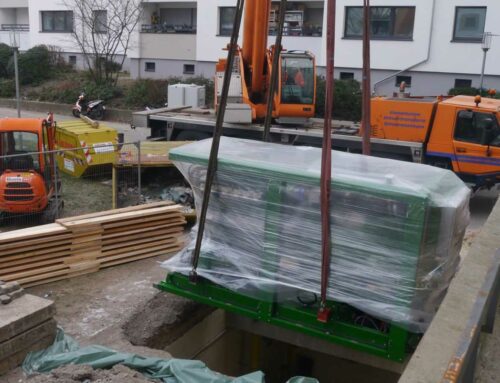
VOLLMERT was commissioned by a regional energy supplier in Lüneburg to install a new MWM block-type thermal power station with a weight of 55 tons in a listed building. The challenge was the installation position of the CHP unit being 2m below the installation level on a 40cm lower concrete foundation. To overcome this offset, the VOLLMERT team used a 4-point lifting scaffold with a maximum load capacity of 125 tons and a statically designed load-bearing scaffold. But before the actual placement could be carried out at the end of this exciting and challenging week, the required rail system in the basement first had to be laid out and leveled, onto which the portal towers were then placed. HEM 300 girders with a unit weight of 1.3 tons each, specially created for this project, were used as endcarriages. One of our partners then installed the load-bearing scaffold, which was designed as a travel lane with HEB 300 girders in the uppermost layer.

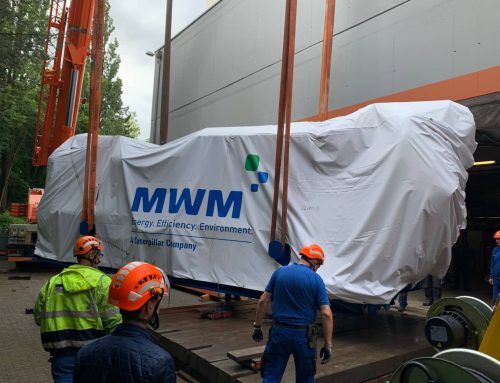
In the early morning of July 1, 2021, our partner Krandienst Schulz set up a telecrane, which was used to unload the engine and set it down in front of the entrance. The engine was pulled onto the load-bearing mast using hydraulic wire rope hoists, before taken over by the lifting mast and moved to its final position. After the load-bearing mast had been removed again, the CHP unit could be lowered to its final position.
2022-05-11T11:02:44+02:00

Projekt 
Avacon Natur

For privacy reasons YouTube needs your permission to be loaded. For more details, please see our Datenschutzerklärung.

Bereits vor einigen Jahren führte  VOLLMERT die Einbringung eines BHKWs in Lüneburg durch. Da dieses BHKW nun durch den Betreiber anderweitig verwendet werden sollte, entschied man sich das „alte“ (immerhin nur fünf Jahre alte) BHKW durch ein neues, wesentlich leistungsstärkeres austauschen zu lassen. Und somit kam wieder einmal VOLLMERT ins Spiel. Der einzige Unterschied: die diesmalige Einbringung gestaltete sich aufgrund der Abmessungen und des Gewichtes des neuen BHKWs als wesentlich herausfordernder.

VOLLMERT wurde damit beauftragt bei einem regionalen Energieversorger in Lüneburg ein neues Blockheizkraftwerk der Marke MWM mit einem Eigengewicht von 55to in ein denkmalgeschützes Bestandgebäude einzubringen. Die Herausforderung bestand darin, dass die Aufstellposition des BHKWs gut 2,00m unterhalb des Einbringniveaus auf einem 1,60m hohen Betonfundament lag. Um diesen Höhenversatz zu überwinden nutze das Montageteam von VOLLMERT ein 4 Punkt Hubgerüst mit einer Maximaltragfähigkeit von 125to und einen statisch ausgelegtes Traglastgerüst. Doch bevor die eigentliche Einbringung zum Ende dieser spannenden und fordernden Woche durchgeführt werden konnte, musste zunächst das benötigte Schienensystem im Keller ausgelegt und nivelliert werden, auf das dann die Portaltürme aufgesetzt wurden. Als Kopfträger kamen eigens für dieses Projekt erstellte HEM 300 Träger mit einem Stückgewicht von jeweils 1,3to zum Einsatz. Durch den Gerüstbauer unseres Vertrauens wurde dann das Traglastgerüst eingebaut, welches in der obersten Lage als Verfahrspur mit HEB 300 Trägern ausgebildet wurde.

In den frühen Morgenstunden des 01. Juli 2021 kamen dann die Kollegen unseres Partners Krandienst Schulz zum Einsatz und bauten einen 220to Telekran auf, mit dem der Motor abgeladen und vor der Einbringungsöffnung abgesetzt wurde. Mittels hydraulischer Seilzüge wurde der Motor konventionell auf Transportfahrwerken auf das Traglastgerüst eingezogen und im Anschluss mit dem Hubgerüst übernommen und an die Endposition verfahren. Nachdem das Traglastgerüst wieder ausgebaut war, konnte das BHKW an seine finale Position abgesenkt werden.

2022-05-11T10:47:27+02:00
Go to Top